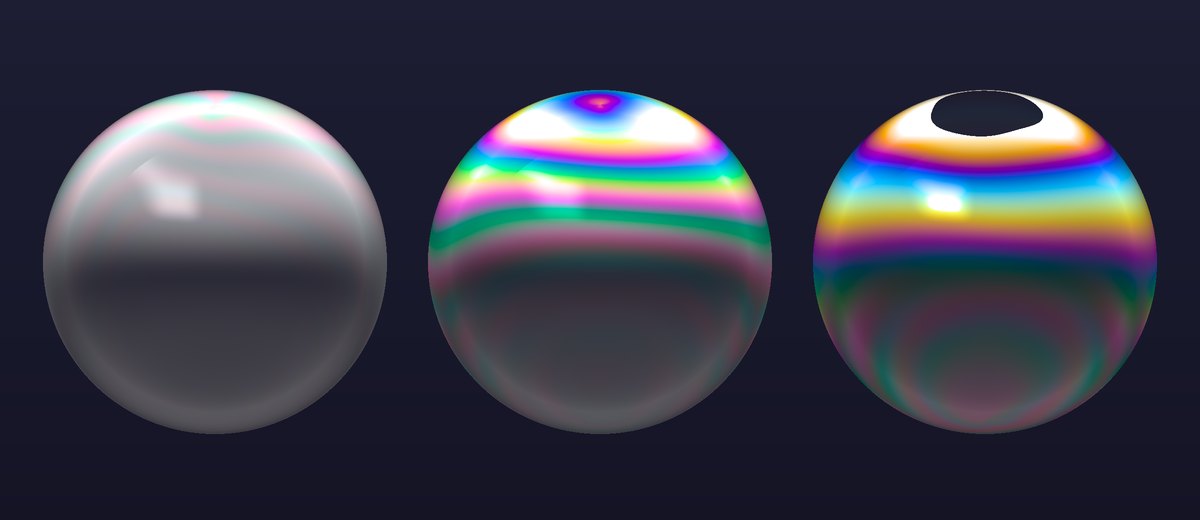
Soap is clear. Water is clear. So is the air inside. Blow the three together and you get gold, magenta, teal, and a blue that looks lit from within, and not one of the ingredients has any color at all.
The colors are a measurement. Every patch of a bubble is reporting how thick its wall is at that spot. And because a bubble's wall only ever gets thinner, the colors arrive in a fixed order, like a clock counting down. Learn the order and you can look at a bubble and tell roughly where it is in its life.
Two reflections
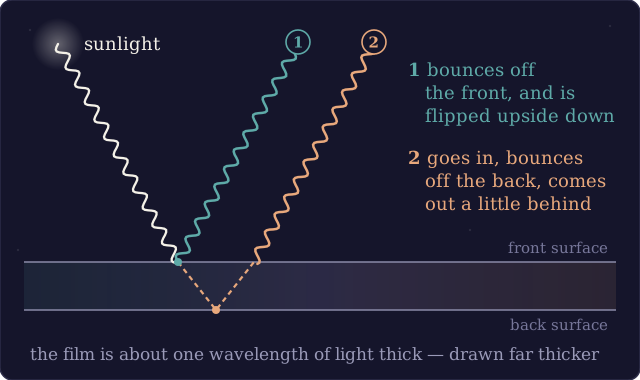
A soap film is a sheet of water about as thick as a wavelength of light (a few hundred nanometers, where a nanometer is a millionth of a millimeter) held between two layers of soap molecules.
When light hits it, almost all of it passes straight through. A little bounces off the front surface. A little more gets inside, bounces off the back surface, and comes back out. So every patch of film sends you two reflections, the second slightly behind the first, because it made an extra trip through the film and back.
Light is a wave, and when two copies of a wave arrive together, they either add up or cancel out, depending on whether their crests line up.
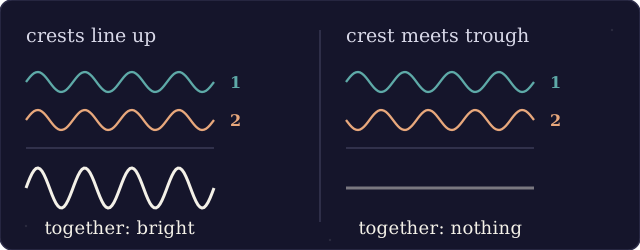
The film's thickness sets the delay between the two reflections. Whether that delay lines the crests up depends on how long the waves are, and every color has its own length: red light's waves are almost twice as long as violet's. So at any given thickness, some colors come back strong and others cancel out.
A film doesn't paint. It subtracts.
Sunlight is every color at once. A film takes it and removes a slice. What you see is whatever's left.

Take out the blues and the remainder looks gold. Take out the reds and it looks blue. Take out the greens and you get magenta, a color with no wavelength of its own, which is why you have never seen it in a rainbow. A rainbow sorts sunlight into its parts. A bubble shows you what's left when one part is missing.
Thin one yourself
The countdown
A freshly blown bubble starts out comparatively thick: roughly a thousandth of a millimeter, often more. At that thickness the canceled slices are narrow and packed close together, like the teeth of a comb, so every color is about half there. The film looks almost colorless.
Then gravity pulls water down the sides, some of it evaporates, and the wall thins, fastest at the top. As it thins, the slices spread apart and the colors surface: faint pinks and greens first, then stronger ones, then the vivid bands.
Isaac Newton watched this happen. To stop the air from stirring the colors around, he covered a freshly blown bubble with a glass, and the colors formed "concentrick Rings incompassing the top of the Bubble," which spread slowly downward and vanished at the bottom, one after another. In Opticks (1704) he listed their order, thickest first:
red, blue; red, blue; red, blue; red, green; red, yellow, green, blue, purple; red, yellow, green, blue, violet; red, yellow, white, blue, black.
Here is his list laid under the colors the physics predicts, computed from nothing but the thickness of the film:

He even noticed that the blues in the early rounds "inclined a little to green." The computed ones do too.
That's the clock. Faint, dirty pinks and greens: the bubble is young. Vivid magentas and blues: it's well along. Gold and white at the top: the last round.
Then black.
Why the last color is black
The two reflections aren't treated equally. Light bouncing off the front surface, going from air into water, comes back flipped upside down: its crests become troughs. Light bouncing off the back, going from water out into air, doesn't flip.
In a thicker film, the flip is just one more ingredient in the delay. But once the film gets far thinner than a wavelength, the delay shrinks to almost nothing and all that's left is the flip. The two reflections come back together, exactly opposed, and cancel. Every color at once.
The film is still there. It has simply stopped reflecting, so against a dark background it looks like a hole. Newton's first thought was that "there had been no Light reflected from the Water in that place." He watched "a small round black Spot" grow at the top until the bubble broke, and, looking closer, found smaller spots inside it that were darker still. He was looking at two different thicknesses of almost nothing. Today they're called common black film, a few tens of nanometers thick, and Newton black film, about five: two layers of soap molecules with nearly all the water squeezed out from between them.
That is the bottom of the countdown. A soap film can't get much thinner, and there's no color left to read. In still, damp air, a black film can hang on for minutes. Out in a breezy garden, most bubbles pop before they get there.
The same trick, elsewhere
Once you can read one film, you start seeing them.
Oil on a wet road. A layer of oil floating on water flips its front reflection and not its back one, just like a bubble, so it shows the same colors in the same order.
Tempered steel. Heat polished steel and a skin of oxide grows on its surface, thicker the hotter it gets. The steel turns straw, then brown, then purple, then blue: light straw at about 205 °C, dark blue at about 310 °C. For centuries, blacksmiths read those colors as a thermometer.
Anodized titanium. An electric current grows an oxide layer on titanium, and the voltage decides how thick it gets. The colors on titanium earrings and bike bolts are picked with a dial.
Your glasses. An anti-reflective coating is a layer built so that its two reflections cancel, the same cancellation that turns a bubble black, done on purpose. It can't cancel every color equally well, which is why a coated lens still glints faintly, usually blue or green.
If you'd like to watch the countdown without getting soap on anything, I made a small toy that computes these colors on bubbles you blow and pop. Soapbubble.dk has real photographs of the bands, with the thicknesses marked. And for the other half of the story (two thousand years of people using bubbles to say life is short), Angelica Frey's essay on the soap bubble trope is a pleasure.
Next time you blow one, watch the top.
Comments
Loading comments...